Sufi music doesn’t live only in spiritual ceremonies or academic research—it circulates through global media, radio, journalism, live festivals, videos, and everyday listening. This page brings together approachable and engaging popular-culture sources that show how Sufi sound is experienced in the wider world. These items help listeners understand how qawwali, whirling, devotional poetry, and Sufi aesthetics appear in modern life, across continents and cultures.
Magazine, News & Media Sources
“Sufi Music’s Rich Past” — Billboard
Bambarger, Bradley, and Isabel Soffer. “Sufi Music’s Rich Past.” Billboard, vol. 108, no. 5, 1996, p. 1. Business Source Complete.
This magazine article introduces Sufi music for a general audience, focusing on its devotional history and emotional expressiveness. It discusses the role of qawwali and percussion in creating a spiritual atmosphere. The piece also touches on how musicians channel sacred messages through performance. Useful because: It demonstrates how mainstream Western media represents Sufi traditions and frames them for music-industry readers.
“Introducing Sufi Fakirs of Bengal” — Christian Century
Carlozo, Lou. “Introducing Sufi Fakirs of Bengal.” Christian Century, vol. 129, no. 15, 2012, p. 41. MAS Ultra – School Edition.
This review introduces listeners to the Sufi Fakirs of Bengal through a contemporary album release. It emphasizes the devotional energy and atmospheric quality of the performances. The article is written for a non-academic religious readership, making it highly accessible. Useful because: It shows how Sufi musical traditions are appreciated outside Islamic or South Asian contexts.
“Allah Be Praised” — Business Today

Hijazi51. “Nusrat Fateh Ali Khan (1948–1997).” Wikimedia Commons, 18 Apr. 2011, https://commons.wikimedia.org/wiki/File:Nusrat_Fateh_Ali_Khan_(1948-1997).jpg.
.jpg)
Chandrasekaran, Kaavya. “Allah Be Praised.” Business Today, vol. 23, no. 1, 2014, pp. 80–82. Business Source Complete.
This article examines how Sufi music has become popular in Indian mainstream culture and Bollywood. It highlights major artists like Nusrat Fateh Ali Khan, Kailash Kher, and A.R. Rahman. The discussion centers on how devotional sound moves into commercial mass media. Useful because: It offers a clear example of the crossover between sacred music and contemporary entertainment industries.
“Best Sufi Serves to the Listeners” — Radio & Music
“Best Sufi Serves to the Listeners.” Radio & Music, 22 Feb. 2016, p. 4. Business Source Complete.
This short feature lists recommended Sufi tracks by well-known South Asian artists. It provides a quick entry point for listeners unfamiliar with qawwali or Sufi-influenced songs. The article highlights both classical and modern pieces. Useful because: It shows how Sufi music circulates through radio and commercial playlists for everyday audiences.
“Stream of Stories” — Marg: A Magazine of the Arts
“Stream of Stories.” Marg: A Magazine of the Arts, vol. 68, no. 2, 2016–17, pp. 114–117. Art Full Text (H.W. Wilson).
This piece includes an interview with artist Sudarshan Shetty, who references a Sufi music festival in Nagore. It highlights how Sufi sound influences visual art and contemporary cultural events. The focus is on creativity, curation, and artistic vision. Useful because: It shows Sufi music in cross-disciplinary artistic spaces, not just musical ones.
“Perfect Circles” — Dance Spirit
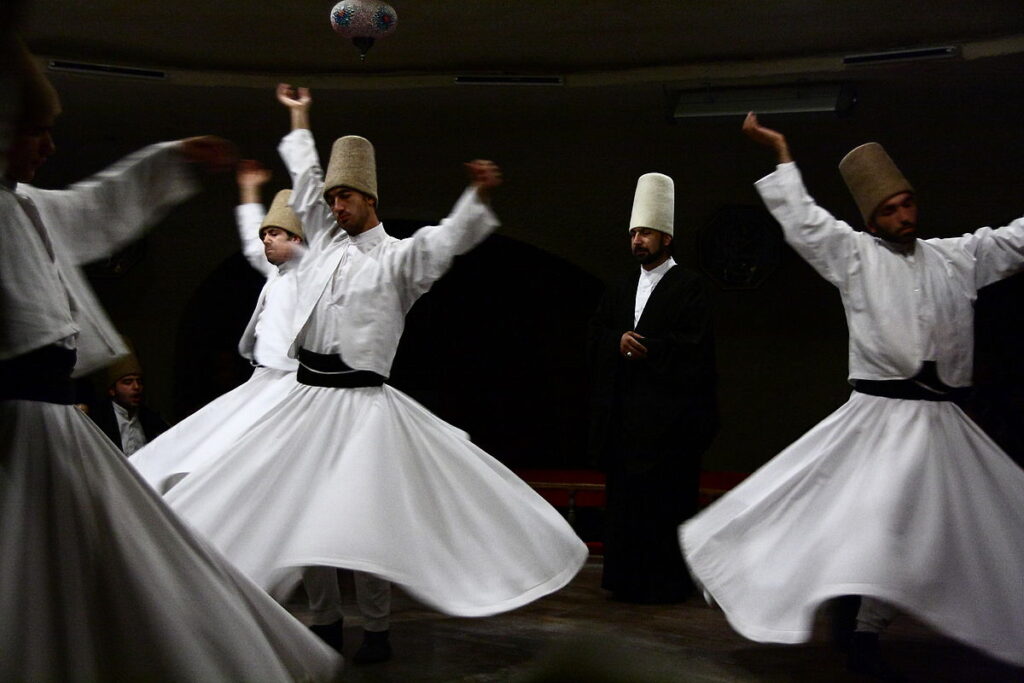
tomislav medak. “Dervishes Avanos.” Wikimedia Commons, 22 June 2006, https://commons.wikimedia.org/wiki/File:Dervishes_Avanos.JPG.

“Perfect Circles.” Dance Spirit, vol. 5, no. 7, Sept. 2001, pp. 45–46. MAS Ultra – School Edition.
This article explains the physical and artistic discipline behind whirling practices performed on stage. It highlights choreography, stamina, and improvisation within whirling performances presented in the U.S. Useful because: It reveals how Sufi whirling is interpreted within dance culture and stage performance.
“Dr. Riad Abdel-Gawad Discusses Egyptian Sufi Musical Traditions” — Washington Report on Middle East Affairs

Aalaa. Tanoura Dance, Egypt. 21 Apr. 2020. Wikimedia Commons, https://commons.wikimedia.org/wiki/File:Tanoura_Dance,_Egypt.jpg.

O’Rourke, Anne. “Dr. Riad Abdel-Gawad Discusses Egyptian Sufi Musical Traditions.” Washington Report on Middle East Affairs, vol. 29, no. 9, 2010, p. 55. Academic Search Complete.
This article summarizes a lecture on Egyptian Sufi musical traditions, focusing on emotional expression and spiritual ecstasy. It highlights both classical and modern influences on Egyptian devotional sound. Useful because: It bridges journalism and ethnomusicology for a general readership.
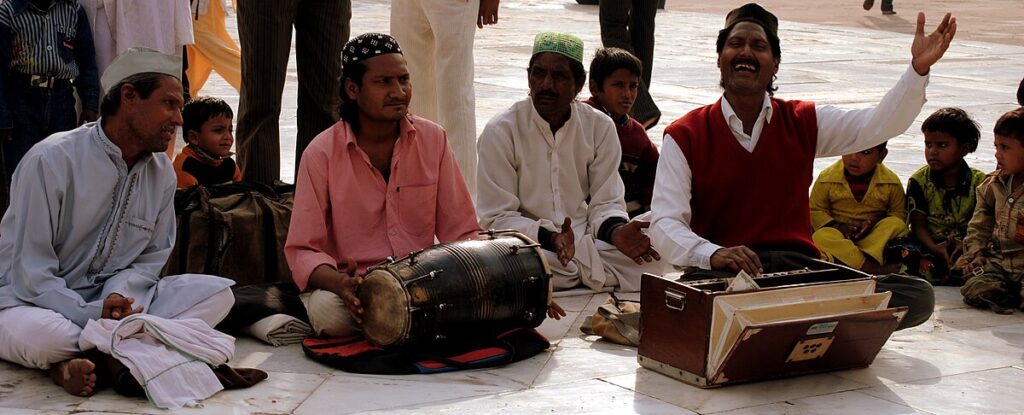
Aghyad. Qawwali Singers at Fatehpur Sikri. 28 Feb. 2022. Wikimedia Commons, https://commons.wikimedia.org/wiki/File:Qawwali_singers_at_Fatehpur_Sikri.jpg.

“Club FM to Host Five Day Music Festival in June” — Radio & Music
“Club FM to Host Five Day Music Festival in June.” Radio & Music, 19 May 2016, p. 1. Business Source Complete.
This short news item announces a major Indian music festival featuring Sufi, folk, and Carnatic music. It shows how Sufi musical genres are included in diverse public festival settings. Useful because: It illustrates how Sufi music appears in contemporary live events and large-scale cultural programming.
“Very Special Sufi Music Connection: Najmuddin Saifuddin & Brothers Qawwali Group…” — Eastern Eye
“Very Special Sufi Music Connection: Najmuddin Saifuddin & Brothers Qawwali Group on Historic Roots in Spiritual Genre.” Eastern Eye, 6 June 2025, p. 20. Regional Business News.
This profile highlights a hereditary qawwali group performing in the U.K., emphasizing their 700-year lineage and commitment to devotional tradition. It discusses cultural identity, global audiences, and the emotional impact of performance. Useful because: It offers a modern example of qawwali’s international reach and living heritage.
Streaming & Multimedia
A Sufi Tale — Langara Streaming Video
A Sufi Tale. 2010. Langara Library Streaming Video Catalogue.
This animated short draws on Sufi storytelling and symbolism, presenting spiritual themes in a visual format. It demonstrates how Sufi concepts appear in modern animation. Useful because: It offers a gentle, accessible introduction to Sufi ideas through narrative media.
Youssou N’Dour’s Sant Yàlla/Egypt — Popular Music
McLaughlin, Fiona. “Youssou N’Dour’s Sant Yàlla/Egypt: A Musical Experiment in Sufi Modernity.” Popular Music, vol. 30, no. 1, 2011, pp. 71–87. JSTOR.
This article analyzes how Youssou N’Dour blends Senegalese Sufi praise traditions with Egyptian orchestral music. It explores global modernity, collaboration, and cross-cultural spirituality. Useful because: It shows how Sufi themes are expressed in world-music markets and global pop culture.
Qawwali Routes in Diaspora — Religions
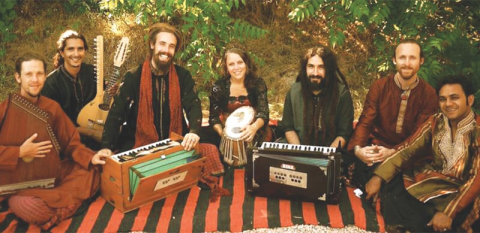
Ludidi, Hugo. “‘When It’s a Tradition, It’s a Different Thing’: The North American Migration of Qawwali and the Work of Fanna-Fi-Allah.” ERea, vol. 23, 2023, journals.openedition.org/erea/19589. Accessed 2 Dec. 2025.
Gaind-Krishnan, Sonia. “Qawwali Routes: Notes on a Sufi Music’s Transformation in Diaspora.” Religions, vol. 11, no. 12, 2020, article 685. Academic Search Complete.
This open-access article explores how qawwali changes when performed by musicians outside hereditary lineages in the U.S. and U.K. It highlights issues of cultural translation, identity, and audience reception. Useful because: It provides a global, contemporary look at Sufi music in diaspora communities.
Global Sufi Communities
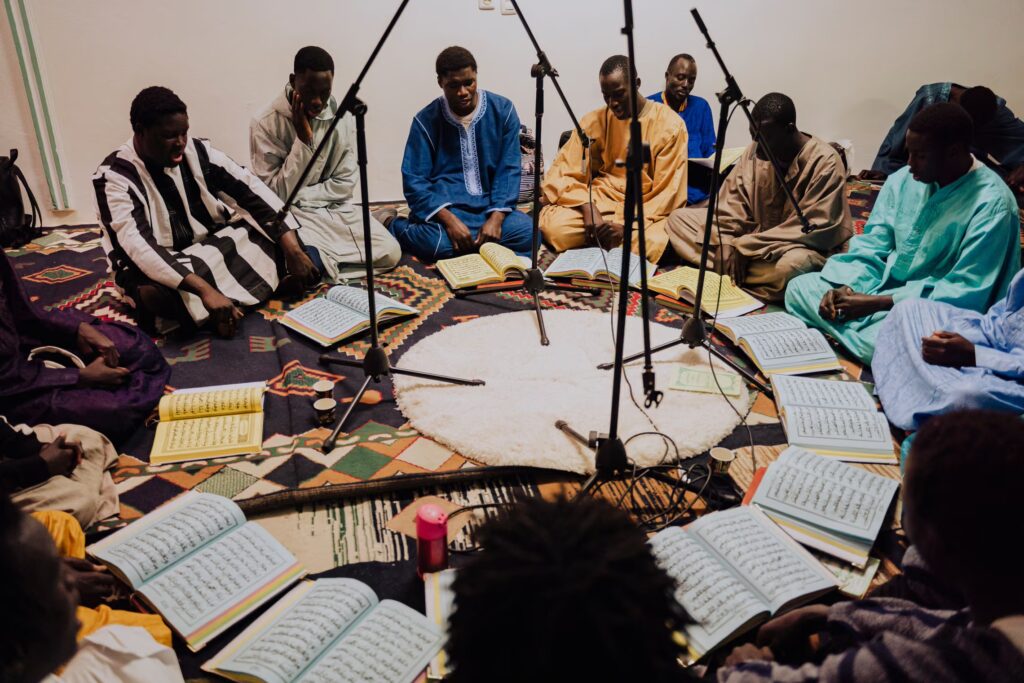
González, Javier. “‘We Feel Like We’re Back in Senegal’: The Sufis Helping Migrants in the Canaries.” The Guardian, 16 Apr. 2025, www.theguardian.com/global-development/2025/apr/16/we-feel-like-were-back-in-senegal-the-sufis-helping-migrants-in-the-canaries.