This section features books that introduce the history, poetry, and spiritual traditions behind Sufi music. You’ll find both easy-to-read overviews and detailed studies of qawwali, whirling, and devotional practice in different regions. These titles are helpful whether you’re researching Sufism or simply curious about the music and the traditions that shape it.
The Dervishes of the North

Xavier, Merin Shobhana. The Dervishes of the North: Rumi, Whirling, and the Making of Sufism in Canada. University of Toronto Press, 2023.
Xavier’s ethnographic study explores how Sufi communities in Toronto, Montreal, and Vancouver practice rituals inspired by Rumi, including samāʿ, whirling, and devotional music. The book examines how these practices appear both in sacred contexts—such as Sufi gatherings—and in public cultural spaces like museums and performance halls. Xavier highlights how Sufi music, poetry, and whirling are adapted within Canadian multicultural settings, revealing the interactions between Islamic mysticism, diaspora identity, and popular spirituality. This source is useful for understanding the contemporary practice of Sufi music and Mevlevi whirling outside their traditional Turkish context and adds a Canadian perspective relevant to modern Sufi communities.
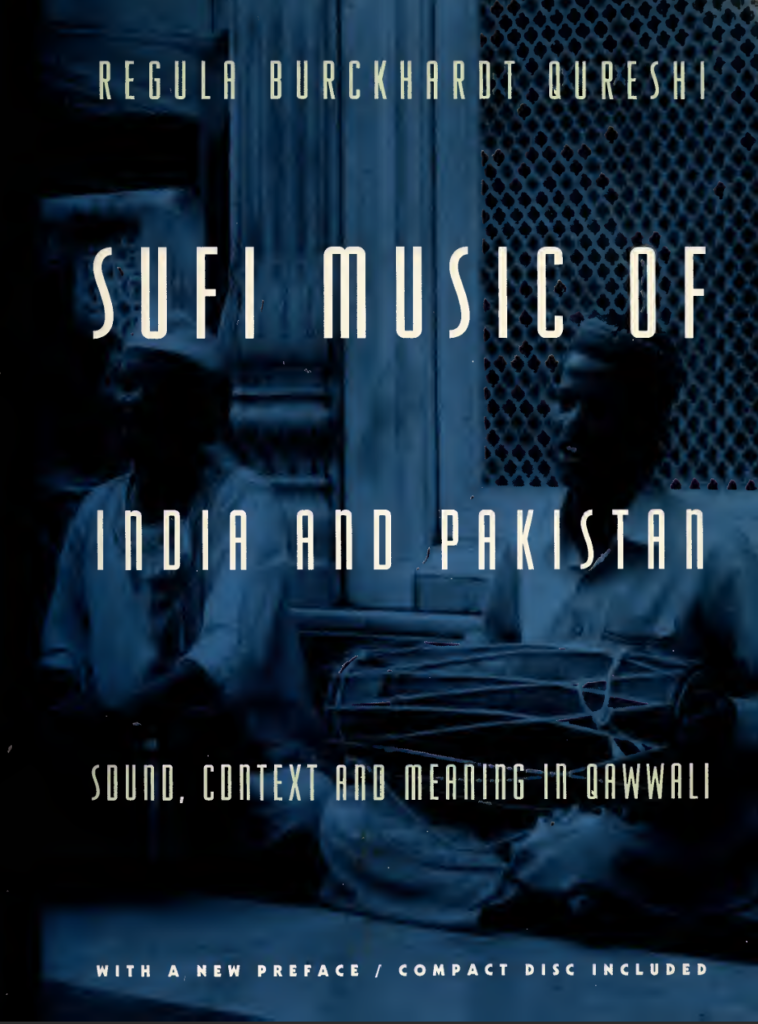
Qureshi, Regula Burckhardt. Sufi Music of India and Pakistan: Sound, Context and Meaning in Qawwali. Cambridge University Press, 1995.
Qureshi’s foundational ethnomusicological study examines qawwali as a Sufi devotional practice through fieldwork, musical analysis, and historical research. She shows how poetry, sound, and participatory performance create spiritual experience in Chishtī Sufi contexts. The book traces qawwali’s development from medieval court patronage to its contemporary forms in shrines and public concerts. Qureshi also explores the social organization of qawwali ensembles and the aesthetics of improvisation. This work is indispensable for defining Sufi music academically and understanding how devotional sound functions in South Asia.
Ernst, Carl W. The Shambhala Guide to Sufism. Shambhala, 1997.
Ernst’s introduction offers a balanced and well-researched overview of Sufism’s history, key figures, beliefs, and devotional practices. His discussions of poetry, remembrance, and ritual gatherings help contextualize the role of music in Sufi spirituality. The book also addresses contemporary misunderstandings about Sufism, linking historical practices to modern contexts. This source provides strong foundational orientation for students before engaging with more specialized studies of Sufi music.
Schimmel, Annemarie. Mystical Dimensions of Islam. University of North Carolina Press, 1975.
Schimmel explores the emotional and symbolic world of Islamic mysticism, with sustained attention to themes that appear in Sufi music, such as longing, intoxication, and divine love. She explains how classical Sufi poets use musical metaphors and describes the spiritual states associated with listening. Although not a musicological study, the book traces the metaphysical foundations from which Sufi musical aesthetics emerge. This work is vital for understanding the religious meaning behind Sufi song texts and the emotional states evoked through performance.